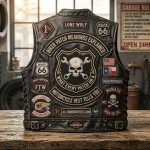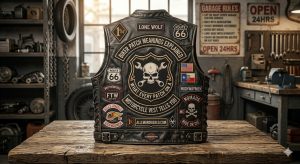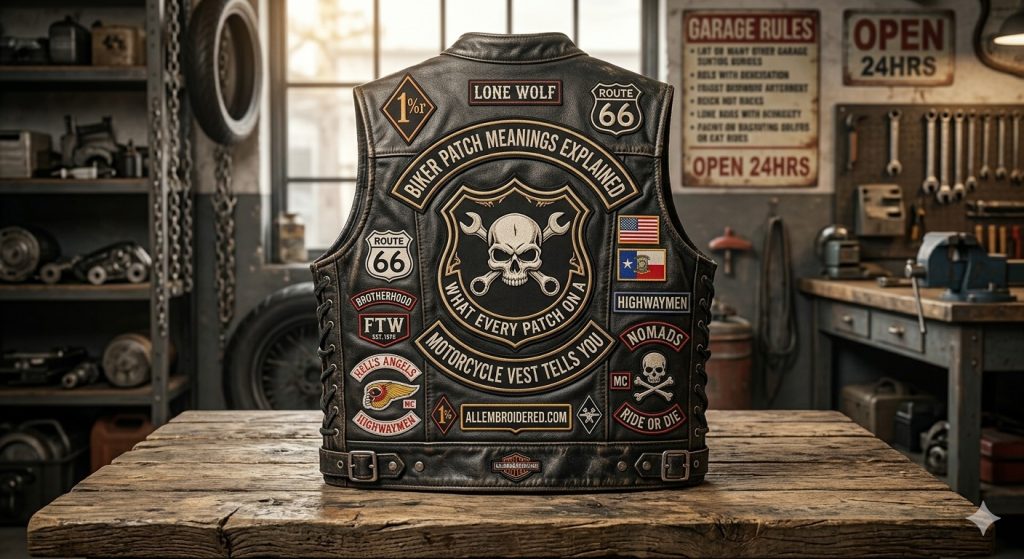
“A biker’s vest is a wearable biography.”
Every patch sewn onto a cut carries meaning — earned meaning, gifted meaning, or deeply personal meaning. Unlike fashion accessories, patches in motorcycle culture carry weight. The wrong patch worn by the wrong person in the wrong territory isn’t a style choice — it’s a statement that carries real-world consequences.
This guide breaks down biker patch meanings from first principles — the history, the hierarchy, the symbolism, and the rules every rider should understand before building their vest.
For placement rules, see our complete biker patches guide and biker vest patch placement rules.
The History of Biker Patches
The biker patch tradition traces back to the years immediately following World War II. Returning veterans — many trained as mechanics and pilots — brought with them a restlessness that didn’t fit neatly into civilian life. Motorcycles offered speed, freedom, and brotherhood. Clubs formed fast, and members needed a way to identify themselves on the road.
The turning point came in 1947 at the Hollister, California rally — an event later mythologised in press coverage as a riot. The American Motorcyclists Association (AMA) distanced itself from disruptive riders by claiming that 99% of motorcyclists were law-abiding citizens. The implication was clear: 1% were not. Some clubs adopted that designation as a badge of honour, and the 1% patch was born.
From that point, patches became the primary language of motorcycle club identity. The back of the vest — the cut or kutte — became the most important real estate in club culture. What you wore on your back announced exactly who you were, who you rode with, and what territory you claimed.
Understanding biker patches meaning starts with understanding that history. These are not decorations — they are earned statements of identity, loyalty, and belonging.
What Are Three-Piece Patches?
The three-piece patch — sometimes called a three-piece set or a full colours — is the defining symbol of a chartered motorcycle club. It consists of three distinct elements sewn onto the back of the cut: the top rocker, the center patch, and the bottom rocker. Together they form a complete declaration of club identity.
- ▸Top Rocker — An arched patch running across the top of the back panel, displaying the club name or city/state of origin. The arc follows the natural curve of the shoulder line.
- ▸Center Patch — The club emblem or logo. This is the most significant piece of the set and the most protected. It represents the club’s identity and is treated as intellectual property within MC culture.
- ▸Bottom Rocker — An arched patch running across the bottom of the back panel, declaring the club’s territory or chapter location. This is often the most politically significant piece of the three.
Wearing a three-piece set is not a decision a rider makes alone. Within formal MC culture, full colours are earned through a process that typically includes a hangaround period, a prospect period, and a club vote. Being patched — receiving full membership — is the culmination of that process.
Only chartered motorcycle clubs wear three-piece patches. Riding clubs (RCs) and social clubs use two-piece or single-patch setups. This distinction is not arbitrary — it is the core language of how the riding community identifies and respects different types of clubs. See our detailed breakdown in the top rocker, center patch, and bottom rocker explained guide.
The 1% Patch — What It Means
The 1% diamond patch is one of the most recognisable — and most serious — symbols in motorcycle culture. Its origin is directly tied to the 1947 AMA statement that declared 99% of motorcyclists law-abiding. The outlaw clubs who embraced the counter-identity proudly began wearing a small diamond-shaped patch displaying “1%” to signal they were the other kind.
The 1% patch is never worn casually. It is not a novelty item, a fashion statement, or a way to look tough on a Sunday ride. Within MC culture, it identifies a club that operates outside mainstream motorcycling associations and follows its own code of conduct. Clubs that wear the 1% patch are referred to as outlaw motorcycle clubs, regardless of any other characteristics.
Important Note on Patch Etiquette
The 1% patch is never worn by riders outside of 1% club membership. Wearing it without that affiliation is considered a serious breach of protocol across the entire riding community — not just by outlaw clubs.
For independent riders and non-MC members, understanding what the 1% patch means is important context for understanding broader biker patch meaning — even if it is a symbol that does not apply to your own vest.
Common Biker Patch Meanings Decoded
The language of biker club patches meanings extends far beyond the three-piece set. Here is a breakdown of the most common patch types, what they communicate, and who typically wears them.
| Patch Type | Meaning | Who Wears It |
|---|---|---|
| Three-Piece Set (Full Colours) | Full membership in a chartered MC — the highest level of club identity | Patched members of chartered MC clubs only |
| Support Patch | Loyalty and solidarity with a specific MC without full membership | Affiliated riders, friends of the club, riding clubs aligned with an MC |
| Rank / Officer Patch | Club role — President, VP, Treasurer, Road Captain, Sergeant-at-Arms etc. | Elected or appointed officers within a club |
| Memorial Patch | Honour for a fallen rider, club member, or fellow biker | Any rider honouring the memory of someone lost |
| Achievement / Mileage Patch | Riding milestone — 100,000 miles, Iron Butt completion, charity ride etc. | Individual riders who have earned the achievement |
| Territory / Chapter Patch | Geographic claim — state, country, or chapter location of the club | MC members (in the bottom rocker position) |
| Novelty / Personal Patch | Personal expression — humour, values, causes, brands | Any rider — no restrictions or earning requirements |
The breadth of patch types reflects the fact that a vest can tell many different stories simultaneously. A single cut might carry earned MC rank patches alongside personal novelty patches and a memorial for a fallen friend. Each layer adds to the biography that the vest tells.
Patch Colours and Their Significance
Colour in MC patches is rarely accidental. Many clubs establish their colours early in their history and protect them fiercely. The combination of background colour and lettering/emblem colour becomes the club’s visual identity — referred to simply as “the colours.”
While specific colour meanings vary by club tradition and region, some conventions recur across MC culture. Red and white is one of the most prevalent combinations in outlaw MC imagery. Black and gold communicates authority and prestige. The choice of colours in a club’s patch design encodes history, allegiance, and often geographic or ideological identity.
For riders outside formal MC membership, colour choices on personal and novelty patches carry less encoded meaning — but awareness of established club colours matters. Inadvertently replicating a known MC’s colour combination can create confusion or friction in riding communities, even without any intention to claim that club’s identity.
This is one more reason why understanding biker patches meaning — including the role of colour — is practical knowledge for any rider building a vest.
Biker Club Patches Meanings — Club-Specific Insignia
Every chartered MC develops its own center patch emblem, and the symbolism embedded in that design is specific to the club’s founding story, values, or geographic identity. A club that formed from military veterans might use military imagery. A club connected to a particular region might incorporate local iconography — state animals, landmarks, or symbols that resonate with the local riding community.
These designs are treated as intellectual property and community identity simultaneously. Clubs are highly protective of their center patch, and replicating or closely imitating another club’s emblem — intentionally or not — is taken seriously. This is true both within the MC community and increasingly in formal intellectual property contexts.
For riders ordering custom patches: Original artwork created specifically for your club or personal identity is always the right approach. Avoid any design that could be mistaken for an existing club’s emblem, regardless of geographic distance or intent.
The depth of meaning in biker club patches meanings reflects a culture that takes identity seriously at every level — from the individual rider to the full-patch club member.
What Patches Should You NOT Wear?
This is the most practically important section for any rider building a vest. The rule is straightforward: patches that represent earned identity — club membership, rank, territory, or the 1% designation — must only be worn by riders who have earned them through legitimate club process.
Wearing a three-piece set without being a patched member of the club whose colours you are displaying is universally understood as a serious breach. It isn’t just frowned upon — in motorcycle club culture, it is considered an act of disrespect significant enough to require a direct response from the club whose identity you are appropriating.
- ✗Three-piece MC patches without being a patched member of that club
- ✗The 1% diamond patch without membership in a 1% club
- ✗A specific club’s bottom rocker territory patch without affiliation
- ✗Officer rank patches (President, Sergeant-at-Arms, etc.) without holding that role
- ✗Any patch design that closely replicates a known club’s center patch emblem
What can any rider wear freely? Novelty patches, personal patches, veteran patches, achievement patches, cause patches, and custom designs that represent your own identity — these carry no restrictions. The distinction between earned club insignia and personal expression is the core of patch etiquette.
Frequently Asked Questions
What does a three-piece patch mean?
A three-piece patch — consisting of a top rocker, center patch, and bottom rocker — signifies full membership in a chartered motorcycle club. The three pieces together communicate the club name, its emblem or symbol, and the territory or chapter it represents. This format is exclusively used by chartered MCs and is never worn by riders outside of legitimate club membership. It is the highest designation in MC patch culture.
What is a 1% patch?
The 1% patch originated from an AMA statement after the 1947 Hollister rally, which implied 99% of riders were law-abiding — and 1% were not. Outlaw clubs embraced this designation and began wearing a small diamond-shaped “1%” patch to identify themselves. Today it signifies membership in a 1% outlaw motorcycle club. It is one of the most serious patches in MC culture and is never worn casually or by non-members.
What is a support patch?
A support patch signals loyalty and solidarity with a specific MC without the wearer being a full patched member of that club. Support patches are typically given by the MC to riders who are affiliated — riding club members aligned with the MC, friends of the club, or individuals who provide services or support. Wearing a support patch without being given it by the club is just as serious a breach as wearing earned member patches without belonging to the club.
Can a non-MC rider wear patches?
Absolutely — with the right patch choices. Any rider can freely wear novelty patches, personal artwork patches, veteran patches, cause patches, achievement patches, and custom designs that represent their own identity. The restriction is specific: patches that represent earned club identity (three-piece sets, 1% patches, specific club colours, rank patches) belong only to riders who have earned or been given them. For independent riders, there is enormous creative freedom within those boundaries.
What do different coloured patches mean?
Patch colours carry different meanings depending on context. In MC culture, colour combinations are specific to each club and treated as the club’s visual identity — “the colours.” Certain combinations have historical associations across the MC world (red and white being one of the most prominent examples). For personal and novelty patches, colour is largely aesthetic. The key practical rule: avoid replicating the colour combination of any known MC club’s full patch set, even inadvertently.
Ready to Build Your Patch Set?
Now that you understand what every patch communicates, build a vest that tells your story. Browse our full range of embroidered patches or commission a custom design — no minimum order required.
Explore our complete biker patches guide for the full resource library.