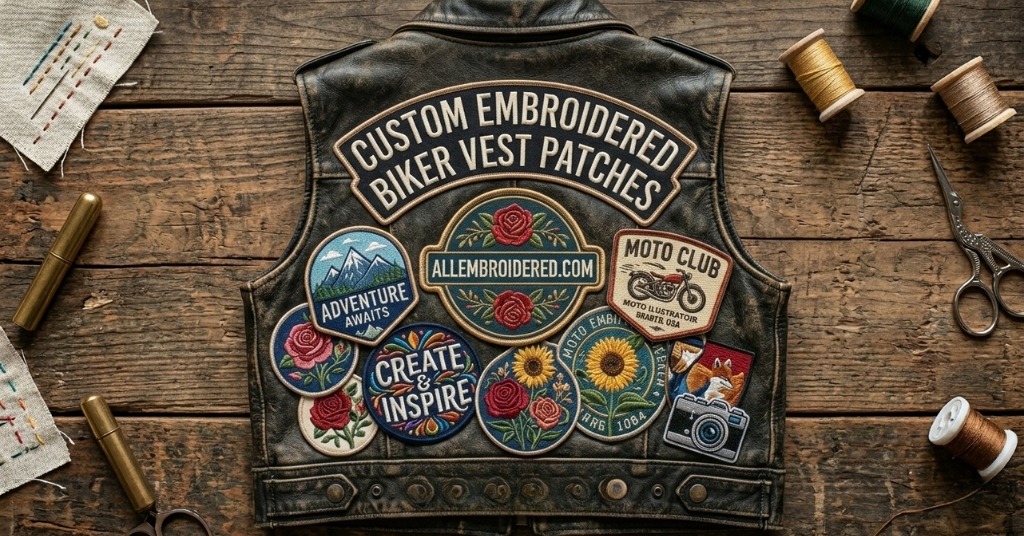
There’s a moment every new MC member knows. You earn your colors, the full patch set gets handed to you for the first time, and something shifts. Those aren’t just pieces of embroidered fabric — they’re your chapter’s identity, your road name, your territory, and your story stitched into thread and twill. Getting them right isn’t just a matter of preference. It matters.
Yet the process of ordering custom embroidered biker vest patches for a motorcycle club is surprisingly confusing for most clubs. Which patch type holds up best on leather? What’s the right embroidery coverage percentage? How do you lay out a full MC vest set properly? And how do you find a supplier who actually understands biker culture — not just someone churning out generic corporate embroidery?
This guide answers all of it. Whether you’re a patch officer ordering a full set of club colors for your chapter, an independent rider personalizing your cut, or a new club trying to nail your first design — you’ll find everything you need to order patches that look sharp, last long, and represent your club the right way.
Why Embroidery Is the Gold Standard for Motorcycle Club Patches
Before getting into design and ordering specifics, it’s worth understanding why the biker community has overwhelmingly standardized around embroidered patches — and why alternatives fall short for serious riders.
Biker patches face conditions no ordinary emblem does. They’re exposed to highway winds at 70+ mph, rain, dust, UV, and the daily stress of vest movement. A printed patch may look crisp in a catalog photo, but the inks fade, the coating peels, and within a riding season it starts looking worn. Woven patches offer fine detail but have a flatter, thinner profile that lacks the visual weight a back patch demands.
Embroidered patches — with their raised thread texture, dense stitch coverage, and robust backing — simply outlast everything else. Browse All Embroidered’s full range of custom embroidered patches to see the difference quality makes.
Understanding Embroidery Coverage: 50%, 75%, and 100%
Coverage percentage is one of the most misunderstood specs when ordering MC patches, and getting it wrong costs clubs money. Here’s what it means in practice:
| Coverage Level | What It Looks Like | Best Use Case |
| 50% or less | Visible background fabric shows through; simpler, text-heavy designs | Budget patches, secondary patches, novelty patches |
| 75% | Minimal background shows; solid color fields, good detail | Standard MC patches, rockers, name patches |
| 100% | Fully covered in thread; maximum color vibrancy and texture | Club back patches, center emblems, premium sets |
For official club colors — the back patch set that represents your MC — 100% embroidery coverage is the professional standard. It produces the deep, vivid colors and the iconic raised texture that riders recognize as legitimate club-quality work. Anything less on a back patch reads as a budget shortcut. Explore our custom embroidered patch options for the highest-impact club emblems available.
Thread Types and Why They Matter
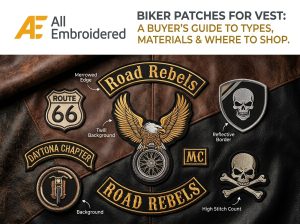
The most durable and widely used thread for biker patches is rayon — bright, colorfast, and available in hundreds of shades that hold their vibrancy across years of riding. Polyester thread offers slightly better UV and moisture resistance and is the preferred choice for patches worn in consistently harsh outdoor conditions. Metallic threads (gold, silver) add visual impact to design elements like borders or lettering but are typically reserved for accent use since they’re more susceptible to fraying over time.
When ordering from All Embroidered, thread color matching is handled during the free sample design stage — you’ll see the actual stitched version before committing to a full order.
The Full MC Vest Patch Set: What Every Piece Means
One of the biggest content gaps in most biker patch articles is the failure to explain what the individual pieces of a club patch set actually mean and how they relate to each other. For anyone ordering for an MC, this isn’t optional knowledge — it’s the foundation of the entire design process.
The Three-Piece Back Patch: Colors of an Official MC
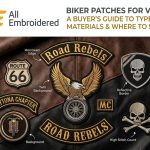
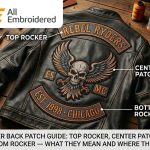
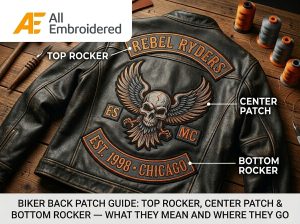
The three-piece patch set — or “colors” — is the defining visual identity of a traditional motorcycle club. It occupies the full back panel of the vest and communicates territory, identity, and earned membership at a glance. Each of the three pieces carries specific meaning:
Top Rocker: The top rocker arcs along the upper edge of the back panel and displays the club’s name. It’s the first thing people read.
Center Patch: The center patch carries the club’s main emblem or logo — skull, eagle, mascot, crest, or custom artwork. This is the heart of the club’s visual identity.
Bottom Rocker: The bottom rocker sits below the center patch and identifies the geographic territory or chapter location.
A small MC patch — typically a square or rectangular tab reading “MC” — is usually placed near the center patch on the back or front panel to designate official motorcycle club status. See how leading clubs like the Hells Angels Motorcycle Club, the Bandidos MC, and the American Motorcyclist Association (AMA) have made patch identity central to club recognition for decades.
Individual Patches That Complete a Full Vest
Beyond the back set, a complete MC vest layout includes several additional patches, each with an established placement and purpose:
| Patch Type | Standard Placement | Purpose |
| Name / Road Name Patch | Left or right chest | Identifies the rider within the club |
| MC Diamond Patch | Front panel or near center back patch | Signals official MC designation |
| Rank / Office Patch | Collar area or front chest | Identifies President, VP, Road Captain, Sgt-at-Arms, etc. |
| 1% Patch (qualifying clubs) | Front chest or over heart | Specific to outlaw/1%er MCs — earned, not displayed casually |
| Chapter / Number Patch | Side panel or front | Chapter number or geographic designation |
| Support / Loyalty Patches | Front panel, side panels | Demonstrate alliance with other clubs or causes |
| Event / Charity Ride Patches | Side panels, lower back | Commemorate specific rides, rallies, or charitable events |
| Memorial Patches | Over the heart or left chest | Honor fallen brothers or members |
For custom name and road name patches for your chapter, All Embroidered handles single patches and full club runs with identical thread consistency.
Backing Options: Which Attachment Method Is Right for Your Vest?
Every biker patch has a backing — the material on the reverse side that determines how it attaches to your vest or jacket. The choice of backing affects durability, installation, and whether patches can be repositioned or transferred. Most biker patch suppliers offer four options, and each has a different use case.
Sew-On Backing: The MC Standard
Sew-on is the default choice for official club patches, full back sets, and any patch that needs to withstand long-term daily wear. There’s no adhesive involved — the patch is stitched directly through the fabric of the vest with strong thread. This makes it essentially permanent and resistant to any environmental condition. Many clubs use a professional seamstress or leather worker for their back patches.
Iron-On Backing: Fast, but Know the Limits
Iron-on backing uses a heat-activated adhesive that bonds to fabric when pressed with a hot iron or heat press. It’s quick and easy for denim vests and works well for smaller secondary patches. The critical limitation: iron-on adhesive does not bond reliably to leather. For leather vests, iron-on patches should always be reinforced with sewing around the edges. Browse custom iron-on patches for denim and fabric applications.
Velcro Backing: For Swap-Ready Gear
Velcro-backed patches attach to a corresponding loop panel sewn onto the vest. This allows patches to be removed and repositioned — useful for military-style vests, sport riders who swap gear between rides, or presentations and events where patches need to come off. For permanent MC colors, Velcro isn’t appropriate, but it’s excellent for tactical vests, outer riding gear, or bags. See our range of custom velcro patches for flexible patch applications.
Backing Recommendation by Vest Material
| Vest / Jacket Material | Recommended Backing | Notes |
| Leather vest (back patch) | Sew-on | Permanent; use heavy thread and leather needle |
| Leather vest (small patches) | Sew-on (or iron-on + sewn edges) | Never iron-on alone on leather |
| Denim cut (back patch) | Sew-on | More forgiving than leather; durable stitch holds well |
| Denim cut (small patches) | Iron-on or sew-on | Iron-on works well on denim; sewing for permanent hold |
| Tactical / sport vest | Velcro | Flexible; allows patch swapping between rides |
If you need custom jacket patches — whether for leather, denim, or tactical wear — All Embroidered advises the right backing for your specific application before production begins.
Notable US Motorcycle Clubs and Their Patch Traditions
Understanding how established clubs use their colors gives context to what patch quality and design integrity actually mean in the riding community. These clubs have made their patches among the most recognizable emblems in American culture:
Hells Angels MC
Founded in 1948, the HAMC uses a trademarked winged skull “Death Head” center patch with red and white rockers. Their patch-earning process is one of the most rigorous in MC culture, progressing from hang-around to prospect to full patch.
Harley Owners Group (HOG)
With over a million members worldwide, HOG is one of the largest factory-sponsored riding clubs. Members earn chapter-specific patches through miles ridden and events attended — a clear example of patch-as-achievement culture in mainstream riding.
Bikers Against Child Abuse (B.A.C.A.)
One of the most respected community MCs in the US, B.A.C.A. uses patch sets to signal their mission and chapter membership. Their colors represent purpose and community rather than territory — a powerful example of what patches communicate beyond club identity.
Buffalo Soldiers Motorcycle Club
Named after the historic African-American Army regiments, the Buffalo Soldiers MC uses patches that pay tribute to military heritage. Their design and color choices are deeply tied to historical significance, making patch accuracy a matter of respect.
Christian Motorcyclists Association (CMA)
With chapters across all 50 states, the CMA uses a distinct cross-and-wheel emblem. Their patch set communicates faith and fellowship rather than territory — and demonstrates how one-piece designs carry just as much meaning as three-piece MC colors.
Iron Order Motorcycle Club
A law-enforcement-friendly MC with chapters nationwide. Iron Order uses a full three-piece patch set and has a well-documented process for territory coordination — a useful reference point for new clubs navigating the patch etiquette landscape.
American Motorcycle Association (AMA)
The AMA represents over 200,000 motorcycle enthusiasts and sanctions countless clubs and events. AMA-affiliated clubs typically use one-piece designs, clearly communicating their non-outlaw status within the broader riding community.
Reading how these established organizations treat their patch identity makes it clear why custom orders deserve the same attention to detail. Whether your club’s identity is built around history, faith, community service, or pure riding culture, your custom biker vest patches should reflect that identity with precision.
How to Order Custom MC Patches: From Concept to Delivery
One of the clearest gaps in competitor content on this topic is the absence of a clear, honest walkthrough of what the ordering process actually looks like. Here’s exactly how it works at All Embroidered — and what to expect at each step.
Step 1: Prepare Your Artwork (Or Don’t — Help Is Available)
Ideally, submit your club logo or patch design as a vector file (AI, EPS, or SVG) — these scale without losing quality and give the embroidery digitizer the cleanest starting point. High-resolution PNG or JPEG files work as well. If your club is starting from scratch, that’s not a problem either. All Embroidered’s design team works from rough sketches, description notes, or reference images to develop a design concept before any production begins.
Key design considerations to communicate when submitting:
- Overall patch dimensions (width x height in inches) for each piece in the set
- Color specifications — PMS color codes if you have them, or reference images
- Border style: Regular border or Satin borders
- Embroidery coverage target: 75% standard, 100% premium
- Backing type for each patch in the set
Step 2: Review Your Free Digital Sample
Within 24 hours of submitting your quote, All Embroidered provides free real sample images showing exactly how your patch will look when stitched — colors, coverage, proportions, and design details. This is your opportunity to request revisions before any production begins.Start your free quote now →
Step 3: Approve and Place Your Order
Once the sample is approved, production begins. Standard turnaround is 7–10 business days from approval, with free shipping to your door in the US. There is no minimum order quantity — whether your chapter needs 3 patches or 300, the process is the same. See how the manufacturing process works from start to finish.
Step 4: Receive, Inspect, and Wear
Patches arrive ready to wear. For back patch sets going onto leather, we recommend having a professional leather seamstress or upholstery shop handle the sewing if you’re not experienced with leather work — the investment is worth it for something as significant as your club colors.
Patch Etiquette: The Unwritten Rules Every Club and Rider Should Know
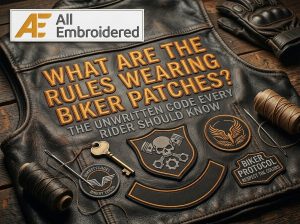
This is the section that almost no patch supplier includes in their content — and yet it’s the information that new riders and clubs need most. Biker patch culture has a well-established code of etiquette that predates online custom patch businesses by decades.
The One-Piece, Two-Piece, Three-Piece Hierarchy
One-Piece: Typically used by riding clubs (RCs), social groups, and AMA-affiliated organizations. It doesn’t claim territory and signals an informal, non-MC status.
Two-Piece: Often indicates a club in transition — typically awaiting territory approval from the established MCs in their region.
Three-Piece: The recognized signal of a full motorcycle club that has claimed and been granted a territory. This format carries the most cultural weight and the most serious expectations.
Patches You Should Never Wear Without Earning Them
Wearing another club’s patches, replicating a recognized club’s colors, or displaying a three-piece set without legitimate MC membership is considered one of the most serious violations in biker culture. When clubs work with All Embroidered, existing club designs are never replicated without proper authorization.
Territory and Regional Awareness
Bottom rockers claim geographic territory. A new club that adopts a bottom rocker for a region that’s already claimed by an established MC will encounter pushback. For further reading on how established clubs manage their patch culture, the Biker Patches: The Meaning Behind Motorcycle Club Patches guide on the All Embroidered blog covers the cultural context in depth.
Caring for Embroidered Biker Patches: Making Them Last a Lifetime
Another topic competitors rarely cover properly: how to actually maintain embroidered patches so they hold up across years of riding. A 100% embroidered back patch represents a real investment — treating it right protects that investment.
- Machine wash cold, inside out, gentle cycle. High-heat washing degrades iron-on adhesive and can cause thread to loosen at the edges over time.
- Avoid the dryer for patches with iron-on backing. Air drying is always the safer option. Dryer heat can cause adhesive to separate from fabric.
- For sewn patches on leather vests, clean with a damp cloth and leather-appropriate cleaner — do not submerge or machine wash leather.
- Store your cut flat or hung, not folded through the back patch area. Repeated folding through the embroidered area can stress the threads at the crease points.
- Touch up loose edges promptly. A single loose thread at a corner, left unaddressed, can unravel a merrowed edge over a full season of riding.
Full MC Patch Set vs. Individual Patches: Which Order Makes Sense?
One of the most practical decisions a club officer faces when budgeting for patches is whether to order a complete set in one purchase or build the vest out piece by piece over time. There are real trade-offs on both sides.
| Factor | Full Patch Set Order | Individual Patches Over Time |
| Cost | Lower cost per patch when ordering together | Higher per-unit cost for small quantities |
| Visual Consistency | Perfect color and thread matching guaranteed | Minor batch-to-batch color variation possible |
| Club Cohesion | All members receive matching sets simultaneously | Gradual rollout; older and newer patches may differ |
| Flexibility | Less flexible if designs evolve | Easy to update individual pieces as needed |
| Budget Timing | Larger upfront investment | Spread cost across multiple orders |
For established clubs ordering a uniform set for all members, a full patch set order is almost always the better value. All Embroidered’s no-minimum policy supports both approaches — full chapter runs and individual replacement patches use exactly the same process and quality standard.
Frequently Asked Questions: Custom Embroidered Biker Vest Patches
1. What’s the difference between embroidered, woven, and printed biker patches?
Embroidered patches are made by stitching thread onto a fabric backing, creating a raised, textured design. They’re the most durable and are the standard for serious MC use. Woven patches use thinner threads for finer detail but have a flatter look. Printed patches use ink on fabric and are less durable — better for novelty or temporary use than for official club colors.
2. How much does a full custom MC patch set cost?
Pricing depends on patch size, embroidery coverage percentage, and quantity. A full set for a small club order typically ranges from $25–$60 per complete set at standard quantities. Get a free custom quote with no setup charges for a personalized estimate.
3. What file format should I use to submit my patch design?
Vector formats (AI, EPS, SVG) are ideal because they scale cleanly without pixelation. High-resolution raster files (PNG, JPEG at 300 DPI or above) also work well. If you don’t have artwork ready, All Embroidered’s design team will develop the design from your sketch, description, or logo reference at no additional charge.
4. What’s the right size for a motorcycle club back patch?
Standard back patches range from 10 to 14 inches wide depending on vest size. A 12-inch width is the most common for medium to large adult vests. The center patch is typically 8–10 inches wide, with the top and bottom rockers spanning slightly wider to frame it.
5. Can I get a single patch made without a minimum order?
Yes. All Embroidered has no minimum order requirement — you can order a single patch or a full club set of hundreds. This makes it practical for individual riders, small clubs just starting out, or club officers who need to replace a specific patch without ordering duplicates of the whole set.
6. Is sew-on or iron-on backing better for leather vests?
Sew-on is significantly better for leather. Iron-on adhesive does not bond reliably to leather surfaces and tends to separate with heat and friction over time. For leather vests, always use sew-on backing. Browse custom leather patch options for leather-specific applications.
7. How long does it take to receive custom biker patches?
Standard production time at All Embroidered is 7–10 business days after artwork approval, plus free shipping to US destinations. If your club has a deadline — a chapter event, rally, or member induction — let the team know upfront.
8. Can I order patches that match exactly what another member of my club has?
Yes, with the original design on file or a clear reference sample. For clubs reordering to match existing patches, providing a physical sample or the original digital file ensures the closest possible color and detail match.
9. What’s the rule about wearing a three-piece patch without being in an MC?
Within traditional biker culture, wearing a three-piece patch without legitimate membership in a recognized motorcycle club is considered highly disrespectful and can create confrontational situations. Independent riders and riding clubs use one-piece or two-piece designs to avoid misrepresentation. For the cultural background, read How to Create Unique Motorcycle Club Patches on the All Embroidered blog.
10. Can All Embroidered handle large chapter orders with multiple ranks?
Yes. All Embroidered regularly fulfills full club orders that include back patch sets, rank patches for officers, prospect tabs, name patches, and MC designations — all in a single order with matching color and thread consistency. Contact the team to coordinate your full set across different member roles.
11. What’s the difference between a merrowed edge and a laser-cut edge?
A merrowed edge is an overlocked stitched border that runs around the perimeter of the patch, creating a raised, rounded edge with a classic finish — the traditional look for most biker patches. A laser-cut (or heat-cut) edge is trimmed cleanly to the exact shape of the design, allowing complex or irregular outlines. Merrowed edges are the standard for back patches and rockers; laser-cut is more common for novelty or logo shapes.
12. Do embroidered patches fade over time from sun and rain exposure?
Quality embroidered patches with rayon or polyester thread are designed to be colorfast and weather-resistant. With proper care — hand or gentle machine washing, air drying, and avoiding prolonged direct sun storage — high-coverage embroidered patches retain their color and texture for years. Learn more about how our patches are made and why quality materials make the difference.
The Bottom Line: Your Club’s Identity Deserves Patches Built to Last
Custom embroidered biker vest patches aren’t merchandise. They’re a club’s identity on the road — the first thing a passing rider reads on your back and the last thing your brothers see when they wave goodbye at the end of a long run. Getting them right means choosing the right embroidery coverage, the right backing for your vest material, a supplier who understands what these patches mean to the community they serve, and a design process that gives you a real preview before anything goes into production.
The combination of no minimum orders, free digital samples, free shipping, and real design support means there’s no reason to settle for generic or compromise on quality. Whether your club needs a complete set of colors for a chapter of 40 riders or a single replacement back patch, the process is the same, and the standard doesn’t change.
Ready to start your MC patch order? Fill out the free quote form, upload your artwork or sketch, and receive your free digital mock-up within 24 hours. No setup charges. No minimum order. Free shipping. Let’s get your club’s colors right.