What Are the Rules for Wearing Biker Patches? The Unwritten Code Every Rider Should Know
Who can wear what, what patches you must earn, what happens if you wear MC colours without permission, and how every rider category — from full-patch MC member to solo independent — fits into the code.
Quick Answer
The rules for wearing biker patches are clear: patches earned through MC membership (three-piece sets, 1% patches, rank patches) must never be worn by unaffiliated riders. Generic patches — novelty designs, veteran patches, cause patches, personal artwork — are free for any rider. The fundamental principle is that every MC patch represents an identity that was earned, not purchased.
Riders new to patch culture often encounter conflicting information online — lists of rules that seem arbitrary, forum posts that contradict each other, and no single clear source that explains why the rules exist and who they apply to. The confusion usually comes from conflating different rider categories under a single set of rules.
The reality is simpler than it appears. What are the rules for wearing biker patches? The answer breaks down cleanly by patch type and rider category — and once you understand the underlying principle, the specific rules follow logically.
For deeper background on biker patch meaning and history, see our biker patch meanings guide. For how social clubs and riding clubs differ from MCs, see our social club vs MC patch rules guide.
The Fundamental Rule — Patches Communicate Earned Identity
Every rule about wearing biker patches flows from one principle: in motorcycle culture, patches are not decoration. They are a language. Every patch on a rider’s cut communicates something specific — club affiliation, rank, territory, achievement, allegiance. When you wear a patch, you are making a statement to everyone who understands that language.
For patches that communicate earned identity — MC membership, club rank, 1% affiliation, territorial claim — wearing them without the underlying reality they represent is not just disrespectful. It is a form of misrepresentation that the community takes seriously and responds to accordingly. The patch says something about who you are. If it says something that is not true, the community’s response is not to ignore it.
For patches that communicate personal expression — novelty, values, achievements, causes — there is no earned identity behind the patch, so there is no rule restricting who can wear it. The restriction is specific to patches that represent an identity that belongs to someone else or a club you are not a member of.
What Patches Can Any Rider Wear Freely?
The list of patches that any rider can wear — MC member, riding club member, social club member, or solo independent — is extensive. These patches carry no ownership or earning requirement.
Novelty and Humour Patches
Funny patches, pop culture references, riding humour. No ownership or affiliation required.
Veteran and Military Patches
Service branch patches, veteran status patches, campaign and unit patches — worn by the rider who served. Wearing military patches you did not earn through service is a separate issue of personal integrity, not MC protocol.
Cause and Charity Patches
Cancer awareness, veteran support, anti-trafficking, environmental causes. Any cause patch is universally appropriate for any rider.
Brand and Manufacturer Patches
Motorcycle manufacturer patches, gear brand patches, oil brand patches — no restrictions for any rider.
Personal Artwork and Custom Designs
Designs that represent your personal identity, values, or aesthetic — with one caveat: the design must not resemble any existing club’s patches or colours.
Achievement and Event Patches
Mileage patches, rally patches, charity ride patches, event patches — any rider who participated or achieved the milestone.
What Patches Require Club Membership or Earning?
These patches are identity documents, not decoration. Wearing them without the underlying membership or achievement they represent is the core of all patch protocol violations.
| Patch Type | Requirement | Severity of Violation |
|---|---|---|
| Three-piece MC set (full colours) | Full patched membership in the specific club | Extreme |
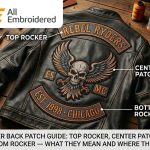
| Bottom rocker (territory) | Full MC membership with territorial standing | Extreme |
| 1% patch | Membership in a 1% outlaw MC | Extreme |
| Rank patches (President, VP, etc.) | Holding that elected or appointed role within your club | High |
| Specific club colours (any club’s design) | Membership in that specific club | High |
These are not suggestions — they are the biker vest patch rules that the entire riding community operates under. They apply regardless of geographic location, club affiliation, or whether anyone who recognises the patches happens to be watching.
The Prospect Process — How MC Patches Are Earned
MC full colours are not purchased — they are earned through a structured process that varies in length and specifics by club but follows a broadly consistent framework across the MC world. The process exists to ensure that full members have demonstrated commitment, character, and genuine alignment with the club’s values before being granted the right to wear the club’s identity.
The typical path begins with a hangaround period — attending club functions as a guest, getting to know members, being assessed informally. An invitation to prospect follows for those who fit. The prospect period involves specific responsibilities, visible identification as a prospect (usually a single rocker or tag), and restricted access to club functions. This period can run from several months to over a year depending on the club.
Full patch status — and with it the right to wear the three-piece set — is granted by club vote. This is why the patch carries the weight that it does. It is a community decision, not an individual one. Being patched means the entire club has vouched for the individual as a full representative of their identity.
Rules for Riding Club and Social Club Members
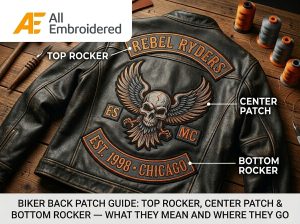
Riding clubs and social clubs have their own patch conventions that are less strict than MC rules but still governed by club decisions. RC members wear the two-piece set that their club has established — top rocker and center patch. The specific designs and colours are decided by the club, and members wear what the club authorises.
Social club members similarly wear patches that their club has established for that membership. The key rule that applies across all non-MC clubs: no three-piece set, no bottom rocker territory claim, no 1% patch. Within those boundaries, club patch decisions are made internally.
What Happens If You Wear Patches You Haven’t Earned?
This question deserves a direct answer. Wearing MC colours, a three-piece set, or a 1% patch without legitimate club membership is not treated as a fashion faux pas — it is treated as an active misrepresentation of identity. The response from the MC community is not uniform across all regions and clubs, but it is consistent in seriousness.
At minimum, the offending patches will be expected to be surrendered. In regions where clubs operate with strong territorial presence, the response may be more direct and physical. This is documented, not hypothetical. Law enforcement agencies globally have documented incidents related to patch protocol disputes — the reality of MC culture around earned colours is neither exaggerated nor a Hollywood fiction.
Why This Rule Is Taken Globally
The three-piece set represents years of commitment, a community of people who have collectively vouched for the wearer, and in many cases territorial standing that has real-world significance. Wearing it without earning it is not a victimless act. It affects the club whose identity is being appropriated and signals to every rider who sees it that the norms governing their community are irrelevant. The response reflects the seriousness with which those norms are held.
Rules for Non-Club Riders — The Safest Patch Choices
Independent riders with no club affiliation have the broadest creative freedom and the simplest set of rules to follow: avoid anything that could be mistaken for earned MC insignia, and wear whatever personal expression patches make sense for your identity.
Specifically: no three-piece configurations on the back panel (even with designs you created yourself), no bottom rockers, no 1% patches, no patches that closely resemble any known club’s centre patch design or colour combination. Outside those boundaries — novelty, veteran, cause, personal artwork, achievement, brand, event — build the vest however you choose.
For inspiration on how independent riders build compelling vests within these guidelines, see our biker patches style guide.
Frequently Asked Questions
Can anyone wear biker patches?
Any rider can wear patches — the question is which patches. Novelty patches, personal patches, veteran patches, cause patches, brand patches, achievement patches, and custom designs that represent personal identity are available to any rider without restriction. The patches that require earning or club membership are specific: three-piece MC sets, 1% patches, rank patches, and specific club colours. Understanding that distinction answers the question for every specific patch type you might consider.
What happens if you wear MC colours without permission?
The response varies by region, club, and circumstance — but it is universally serious. At minimum, the wearer will be expected to remove the patches immediately. The club whose colours are being worn will typically become involved. In areas with strong MC territorial presence, the response can extend beyond social confrontation. This is not speculation — it is documented reality across multiple countries and decades of MC culture. The rule exists precisely because the community enforces it.
Can a woman wear MC patches?
The same rules apply regardless of gender. Women who are full patched members of chartered MCs wear the club’s colours. Women who are members of riding clubs or social clubs wear those clubs’ designated patches. Women riding independently follow the same guidelines as any independent rider — personal, novelty, and cause patches freely; earned MC insignia only if actually earned. Some MCs have women’s auxiliaries with their own patch conventions — members of those organisations wear those designated patches.
Are there rules about biker patches on jackets vs vests?
The protocol rules — what patches you can wear — apply to any garment, not just the traditional vest. An MC member wears their club’s three-piece set on the cut, which is typically a vest, but the earned status of the patch does not change based on which garment it is sewn to. For independent riders, the same restrictions on three-piece configurations and MC insignia apply whether the garment is a vest, jacket, or denim cut. The garment type does not create exemptions from patch etiquette.
How do I know if a patch is club-specific?
Research before you sew. If a patch design includes a specific club name, acronym, or logo — it is club-specific. If a custom design uses a colour combination that resembles a known local club’s colours — research it before proceeding. General imagery (skulls, eagles, flames, wings) is not inherently club-specific. But a combination of specific colours, text, and imagery that closely resembles a known club’s three-piece set should be treated as club-specific until confirmed otherwise. When in doubt, consult experienced riders in your local community before ordering custom patches.
Build a Vest That Respects the Code
Now that you know the rules, build your vest with confidence. Browse our full patch range — novelty, personal, veteran, cause, and custom — or order a bespoke design that represents your own riding identity.
Also read: Biker Patch Meanings Guide | Social Club vs MC Rules | Complete Guide