Biker Back Patch Guide: Top Rocker, Center Patch & Bottom Rocker — What They Mean and Where They Go
The three-piece back patch is the defining symbol of a chartered MC. Every element has a precise position, a precise meaning, and rules that have been consistent across motorcycle club culture for decades.
Quick Answer
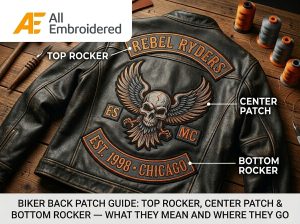
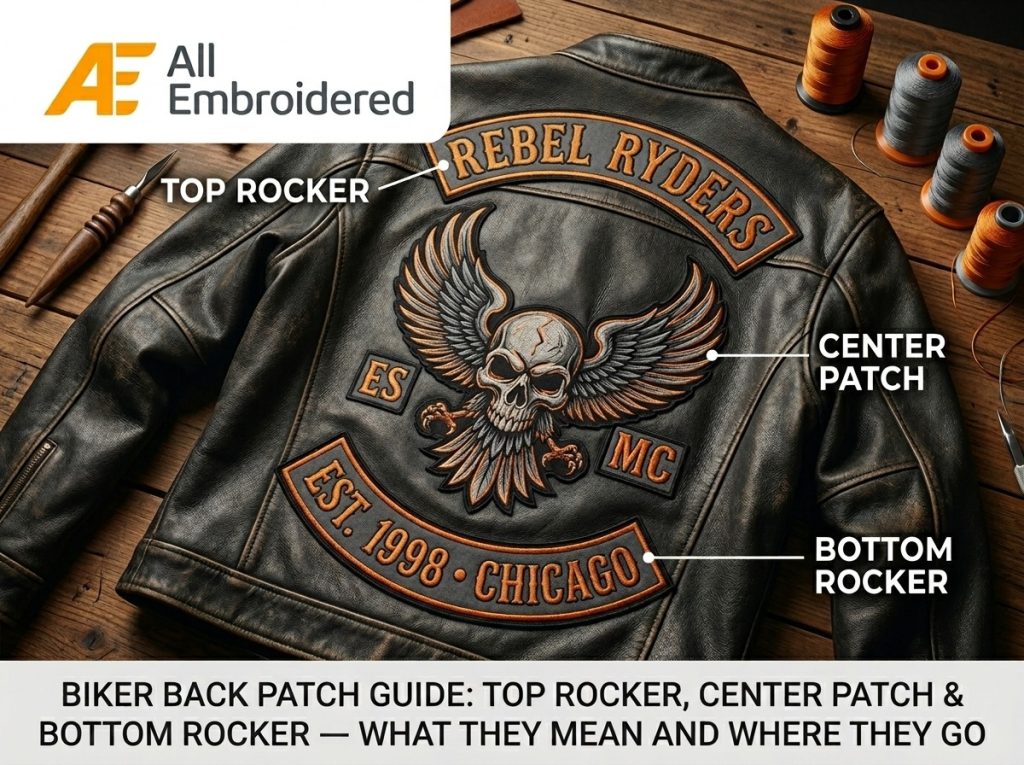
A biker vest back patch set consists of three pieces: the top rocker (club name, arched across the top), the center patch (the club emblem or logo), and the bottom rocker (territory or chapter, arched across the bottom). This three-piece format is exclusively associated with chartered motorcycle clubs and is never worn by unaffiliated riders.
The back of a biker’s vest is the most significant real estate in motorcycle club culture.
It is what the world sees when a rider is in motion — at speed, in formation, pulling into a venue. The back panel communicates club identity, territorial claim, and earned membership status to every rider who understands the language. For chartered MCs, every element of the biker vest back patches configuration is deliberate and governed by convention that has held consistent for decades.
This guide breaks down each element of the three-piece set — what it communicates, where it sits, how it is sized, and what earning it means. For the full placement picture including front panel and sleeves, see our biker vest patch placement rules guide. For broader patch meanings, visit our complete biker patches guide.
The Three-Piece Patch — What It Is
The three-piece patch — also called full colours or a three-piece set — is the defining symbol of a formally chartered motorcycle club. The term refers to the three distinct embroidered pieces worn on the back of a cut: the top rocker, the center patch, and the bottom rocker. As individual patches they are components. As a set, they constitute the most important declaration in MC culture.
The format originated in the post-WWII American MC scene and has remained structurally unchanged across decades of club culture evolution. The configuration is universally understood — in the US, Europe, Australia, and wherever MC culture has taken root. A three-piece set on someone’s back communicates, without ambiguity, that the wearer is a patched member of a chartered club.
| Element | Position on Back | What It Communicates |
|---|---|---|
| Top Rocker | Arched across the upper back panel, below the collar | Club name or city/state of origin |
| Center Patch | Centre of back panel, between the two rockers | Club identity, emblem, and values |
| Bottom Rocker | Arched across the lower back panel, above the hem | Territory claim or chapter name — the most politically significant element |
Together, these three elements function as a complete identity statement — club name, emblem, and territory, all readable from distance in a single back panel. Nothing else in riding culture communicates equivalent information in equivalent brevity.
Top Rocker — Meaning and Placement
The top rocker is an arched embroidered patch that sits at the highest point of the back panel, immediately below the collar seam. Its arc follows the natural curve of the shoulder line, and its width spans most of the upper back — typically 10 to 12 inches — so it is clearly legible from several metres away.
In most club traditions, the top rocker displays the club’s name. Some clubs use the top rocker to display the city or state of origin instead, particularly in clubs where the name is already incorporated into the center patch design. The choice is club-specific and established during the founding of the club’s patch design.
The font, thread colour, and background colour of the top rocker are part of the club’s overall colours — the visual identity that distinguishes one club from another. Many clubs protect their specific colour combination fiercely, viewing the combination of text style and colour on the top rocker as as much a part of their identity as the center patch emblem itself.
Standard top rocker dimensions: 10–12 inches wide, 2–2.5 inches tall. The patch height accommodates the arc while keeping the text at a size that is clearly readable from a distance. Nothing is placed above the top rocker on the back panel — it is always the uppermost element.
Center Patch — The Club Emblem
The center patch is the most significant and most protected element of the three-piece set. It occupies the middle third of the back panel — between the two rockers — and carries the club’s emblem or logo. This is the design that becomes synonymous with the club’s identity in the riding community, and clubs treat it with a seriousness comparable to how corporations protect their trademarks.
Center patch designs vary widely: some clubs use skulls, eagles, or other imagery with roots in post-WWII biker symbolism. Others use designs that reference the club’s founding story, geographic location, military heritage, or values. The specific imagery is less important than the fact that it is original to the club — an emblem that has not been used by any other club.
Why Replication Is a Serious Offence
Replicating or closely imitating another club’s center patch design — intentionally or inadvertently — is treated as one of the most serious breaches possible in MC culture. The center patch is the visual identity of the club. Using it without affiliation is the equivalent of impersonating the club itself. For anyone commissioning custom patches, thorough research to confirm your design does not resemble any existing club’s emblem is not optional — it is essential.
Standard center patch dimensions: 8–12 inches wide × 9–11 inches tall. It is proportionally the largest element of the three-piece set and the dominant visual anchor of the entire back panel. Its size should ensure that the rockers above and below frame it rather than compete with it.
Bottom Rocker — Territory and Chapter
The bottom rocker is the most politically significant piece of the three-piece back patch set. Positioned arched across the lower back panel above the hem — the mirror image of the top rocker — it declares either the club’s territorial claim or the specific chapter name, depending on the club’s convention.
When a bottom rocker displays a state, country, or region name, it is communicating that the club considers that territory its home ground. This is not a casual or symbolic claim — in regions with established MC communities, territorial bottom rockers are taken seriously by all clubs operating in the area. How clubs manage shared territories, border regions, and overlapping claims is governed by protocols that vary by region but are universally understood to be significant.
Some clubs use the bottom rocker for a chapter name rather than a geographic territory — “Mother Chapter,” “East Side,” “Founded Chapter” — reflecting the club’s internal structure rather than a territorial declaration. The choice is made by the club and communicated through established club tradition.
The critical rule for non-MC riders: the bottom rocker is never worn by riding clubs, social clubs, or independent riders. Its absence from two-piece patch sets is not an oversight — it is the deliberate signal that communicates “we are not claiming territory.” Wearing a bottom rocker without MC standing is the single most serious patch protocol violation in riding culture.
Standard bottom rocker dimensions match the top rocker: 10–12 inches wide, 2–2.5 inches tall, with an identical arc radius to ensure the two rockers read as a visually matched pair framing the center patch.
Biker Vest Back Patch Sizing Guidelines
The three elements of a biker back patches for vest set must work as a proportional unit. Sizing any individual element incorrectly disrupts the visual system — a center patch that is too small leaves the back panel feeling incomplete; rockers that are too narrow look like afterthoughts against a large center patch.
- ▸Top rocker: 10–12 inches wide × 2–2.5 inches tall. Arc should follow the shoulder curve naturally.
- ▸Center patch: 8–12 inches wide × 9–11 inches tall. Should dominate the back panel as the primary visual element.
- ▸Bottom rocker: Match the top rocker exactly — same width and arc radius — for visual symmetry.
- ▸Spacing: ¼ to ½ inch of visible vest material between each element. Enough gap to read as three distinct pieces; close enough to read as a unified set.
Earning Your Three-Piece Back Patch
In formal MC culture, full colours are never purchased — they are earned through a process that tests a prospective member’s commitment, character, and compatibility with the club. The timeline and requirements vary by club, but the broad framework is consistent across the MC world.
The process typically begins with a hangaround period — attending club events as a guest and being assessed informally. If invited to formally pursue membership, the individual becomes a prospect: a status that carries specific responsibilities, restricted access to club functions, and an identifiable patch (usually a “Prospect” rocker or tag). The prospect period can last from months to years depending on the club.
Full membership — and the right to wear the three-piece set — is granted by club vote. Being patched is the culmination of the process and marks the member as a full, trusted representative of the club. The back patch is literally handed over, not bought. This is why wearing it without going through that process carries the weight that it does in MC culture.
Biker Back Patches for Vest — Non-MC Options
Riders who are not members of a chartered MC can still build a compelling back panel. The back of the vest is powerful real estate regardless of club affiliation — and there are strong approaches that make effective use of it without any MC format or territorial claim.
Large Single Statement Patch
A single large embroidered patch — 10 to 14 inches — centred on the back panel. Bold, clean, immediately readable. Works for personal artwork, brand patches, cause patches, or any design that has meaning to the individual rider without making a territorial or membership claim.
Custom Artwork Panel
A bespoke design commissioned specifically for the back panel — personal imagery, a custom logo, an original design that represents the rider’s identity. The highest investment option but produces the most unique and authentic result. See our biker patches style guide for layout principles.
Riding Club Two-Piece
For riding club members: a top rocker and center patch without a bottom rocker. This is the correct and respected format for RC clubs. The two-piece back panel communicates organised club identity without the territorial claim of a bottom rocker — appropriate and understood throughout the riding community.
Frequently Asked Questions
How big should a back patch be on a vest?
For a three-piece MC set, the center patch should be 8–12 inches wide and 9–11 inches tall — large enough to dominate the back panel as the primary visual element. Rockers sit at 10–12 inches wide × 2–2.5 inches tall. For a single statement patch on a non-MC vest, 10–14 inches is the effective range: large enough to fill the back panel without bleeding into seam areas. Always lay the patch on the vest before ordering to confirm the scale works for your specific vest dimensions.
What is the correct order of the three pieces?
From top to bottom: top rocker, center patch, bottom rocker. The top rocker is always the uppermost element — nothing sits above it on the back panel. The center patch occupies the middle zone and is the largest visual element. The bottom rocker is always the lowest element on the back panel. This vertical order is universal across MC culture and does not vary by club or region. Deviating from it signals either inexperience or intentional disregard for convention.
Can I wear a bottom rocker if I’m not in an MC?
No — the bottom rocker is exclusively the domain of chartered MC members. It is the territorial claim element of the three-piece set, and wearing it without MC standing is the most serious patch protocol violation in the riding community. Riding clubs deliberately omit the bottom rocker from their two-piece patch setup as a sign of respect for this convention. Independent riders and social club members do not wear bottom rockers under any circumstances.
What is a two-piece patch set?
A two-piece patch set consists of a top rocker and a center patch — without a bottom rocker. This is the standard format for Riding Clubs (RCs) and some social clubs. The two-piece configuration communicates organised club identity without the territorial claim of the bottom rocker. It is a legitimate and respected patch format in the riding community, understood to signal RC or social club affiliation rather than full MC chartered status.
Source Your Back Patch Set
Whether you need a custom rocker set for your club, a large statement patch for your personal vest, or stock patches for any position on the cut — we supply embroidered and woven patches with no minimum order and full colour-matching capability.
Also read: Vest Patch Placement Rules | Biker Patches Style Guide | Complete Guide